Major AI chat platforms are rapidly evolving from conversational interfaces into agentic environments. Grok’s recent introduction of custom skill creation and upload, along with custom MCP connectors, is a clear signal: the way founders deliver and distribute products is about to change dramatically.
This moment builds on important groundwork from the open-source community. Projects like OpenClaw (and the broader ecosystem of local-first agentic tools) have been instrumental in popularizing composable agent skills, extensible tool use, and the practical potential of AI that can act autonomously on behalf of users. By creating thriving community skill registries and demonstrating real-world agentic workflows, these open-source efforts educated thousands of builders and created visible user demand for standardized capabilities.
The foundational pattern — standardized agent instructions via AGENTS.md and SKILL.md files — was first proposed and championed by Anthropic. They introduced these constructs into Claude Code, Claude Cowork, and influenced many frontier labs (including Grok). While Anthropic originated the idea, it was open-source tools and communities that took the concept and ran with it, creating the rich ecosystem we have today.
History is repeating a familiar pattern. Just as Linux and open web technologies in the early internet era pushed commercial providers to adopt user-desired standards and interoperability, open-source agentic projects are now accelerating the adoption of skills and protocols like MCP across major commercial AI platforms. Open source continues to prototype what users actually want, while commercial distribution channels bring those ideas to the mainstream.
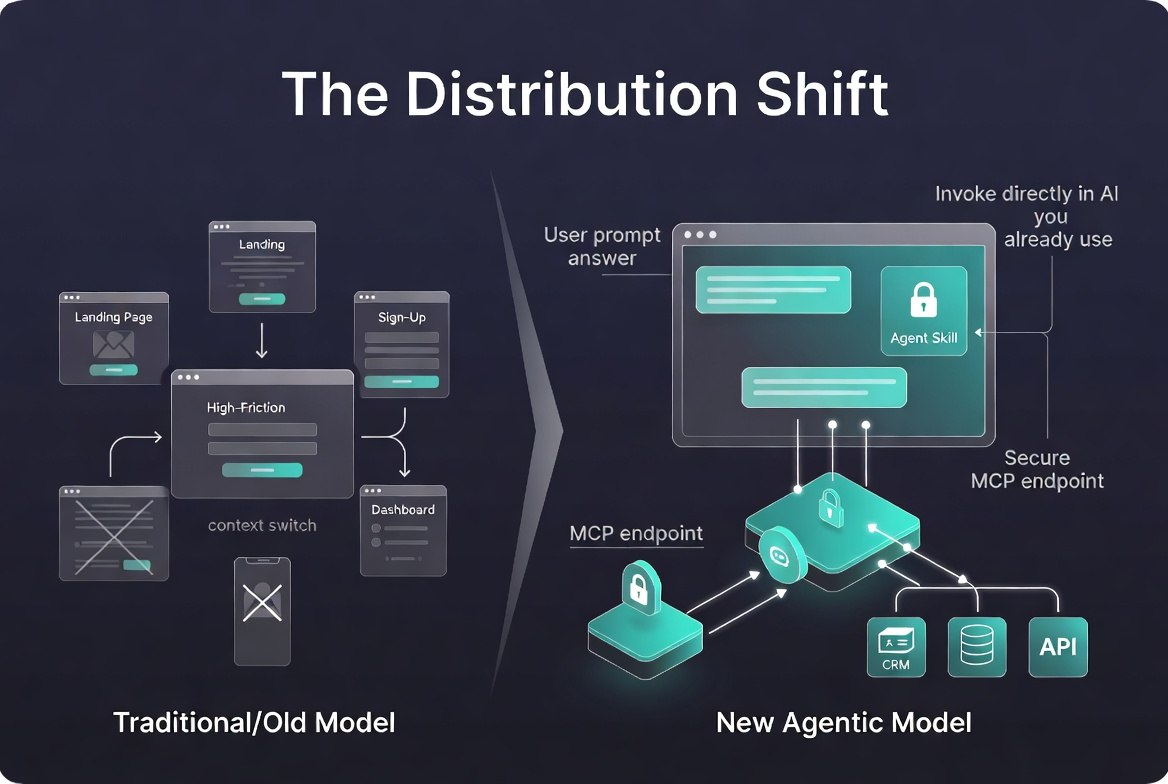
You no longer need to rely solely on users discovering your standalone app, website, or SaaS dashboard. You can now package core value as agentic skills that users invoke directly inside the AI apps they already live in — Grok, ChatGPT, Gemini, Claude, and others. Backend power (data, workflows, specialized logic, archives) can be exposed securely through standardized MCP (Model Context Protocol) endpoints.
This creates a powerful new distribution channel and entirely new product architectures. Distribution happens at the point of user intent, inside their favorite AI assistant.
The Distribution Shift
Traditional standalone apps and websites vs. the new agentic model where value is delivered directly inside users' favorite AI chat apps via skills and MCP endpoints.
What Founders Can Actually Build
Agent Skills are reusable, invocable capabilities the AI can call on the user’s behalf (custom actions, workflows, or mini-expertise packages).
MCP Endpoints are secure, standardized servers that let AI assistants safely connect to your systems for tools, context, data retrieval, and actions — with proper consent, authentication, and auditability.
Together they turn your product into something that lives inside the user’s AI experience.
New Product Types Founders Can Sell & Distribute
The real unlock is the variety of new product shapes this enables.
1. Vertical Skill Bundles
Packaged, ready-to-use skills for specific industries or workflows (e.g., personalized practice PDF generators for teachers, symptom tracking + doctor communication skills for healthcare, equipment diagnostic troubleshooters for manufacturing).
2. MCP Infrastructure Services
The "plumbing" layer: HIPAA/SOC2-compliant MCP servers, secure archives, consent management, and high-reliability hosting that other skill builders rely on.
3. Skill Marketplaces & Discovery Platforms
Domain-specific marketplaces where users discover and install skills that solve their exact problem. Think “Shopify for agent skills” — curated, rated, and instantly invocable inside the user’s AI.
4. Trusted Knowledge Archives & Retrieval
Secure, consent-gated archives of documents, research, customer data, or institutional knowledge that AI assistants can query on behalf of authorized users — with full audit trails and revocation.
Security and consent architecture when operating inside another company’s AI interface is non-negotiable. Every MCP endpoint must enforce authentication, rate limits, data minimization, and explicit user consent at the point of invocation.
The Bigger Picture
We are witnessing the emergence of an agentic distribution layer on top of the major AI platforms — accelerated by the powerful combination of open-source innovation and commercial reach. Open-source projects like OpenClaw helped define and popularize what agentic skills and extensible AI look like in practice. Commercial platforms are now scaling those ideas with better distribution, polish, and accessibility.
Just as mobile app stores redefined software distribution, agent skills and MCP endpoints are redefining how specialized capabilities reach users — more directly, more conversationally, and with dramatically less friction. This dynamic — open source pushing boundaries and commercial platforms delivering at scale — is a hallmark of healthy progress toward more capable agentic systems and the broader agentic economy.
Founders who embrace this shift early can build products that feel native to how people will actually work and solve problems going forward.
The options for how you deliver and distribute your product just expanded significantly. What will you build first?