What if your home robot could learn from every other robot in the world—without ever sharing what happens inside your home? That's the premise behind zk0.bot, an open-source federated learning platform for robotics AI that I've been building and presenting about at meetups from Austin to Buenos Aires.
Over the past several months, I've had the privilege of sharing this work with diverse communities—the Austin Robotics AI community, the Austin Python Meetup, and at ETH Argentina Devconnect in Buenos Aires. The response has been electric: founders, engineers, students, and investors are all recognizing that decentralized, privacy-preserving AI training is not a niche research topic—it's the future of how robots will learn.
The Problem: Centralized Robot Training Doesn't Scale
Today's robotics AI relies on centralized data collection. Companies like Tesla, Google DeepMind, and Figure vacuum up enormous datasets from robot interactions, train massive models in proprietary data centers, and then deploy them back to the fleet. This approach has fundamental limitations:
- Privacy — Robots operating in homes, hospitals, and offices capture deeply personal environments. Sending that data to a central server is a non-starter for many use cases.
- Bandwidth — Video and sensor data from thousands of robots generates petabytes. Uploading everything to the cloud is expensive and slow.
- Regulation — GDPR, HIPAA, and emerging AI regulations increasingly restrict cross-border data movement. Centralized training creates compliance nightmares.
- Single point of failure — One company controls the model, the data, and the training pipeline. If they pivot, get acquired, or shut down, every robot in the fleet goes dark.
"The most capable robots of the next decade won't be trained in a single data center. They'll learn from a decentralized network of builders, each contributing local knowledge without surrendering privacy."
The Solution: zk0.bot and Federated Learning
zk0.bot solves this with federated learning—a distributed training paradigm where each robot (or simulation node) trains on local data and only shares model updates, never raw data. The platform is built on:
- Flower Framework — The industry-standard open-source federated learning framework, enabling secure, scalable aggregation of model updates across distributed clients.
- SmolVLA Models — State-of-the-art vision-language-action models optimized for robotics manipulation tasks, trained on the SO-100 dataset of real-world interactions.
- Zero-Knowledge Proofs — zkML on-device allows robots to generate mathematical proofs of computational integrity, ensuring that model updates are legitimate without revealing the underlying training data.
- Docker-based Deployment — Production-ready infrastructure with CLI tools for node operators to join the federated network with their own hardware and datasets.
The architecture is elegant: a central coordination server manages training rounds, while distributed clients train locally on private data and submit encrypted model weight updates. The server aggregates these updates into an improved global model that benefits everyone—without any single participant having access to another's data.
Austin Robotics AI Meetup: From DIY to Decentralized
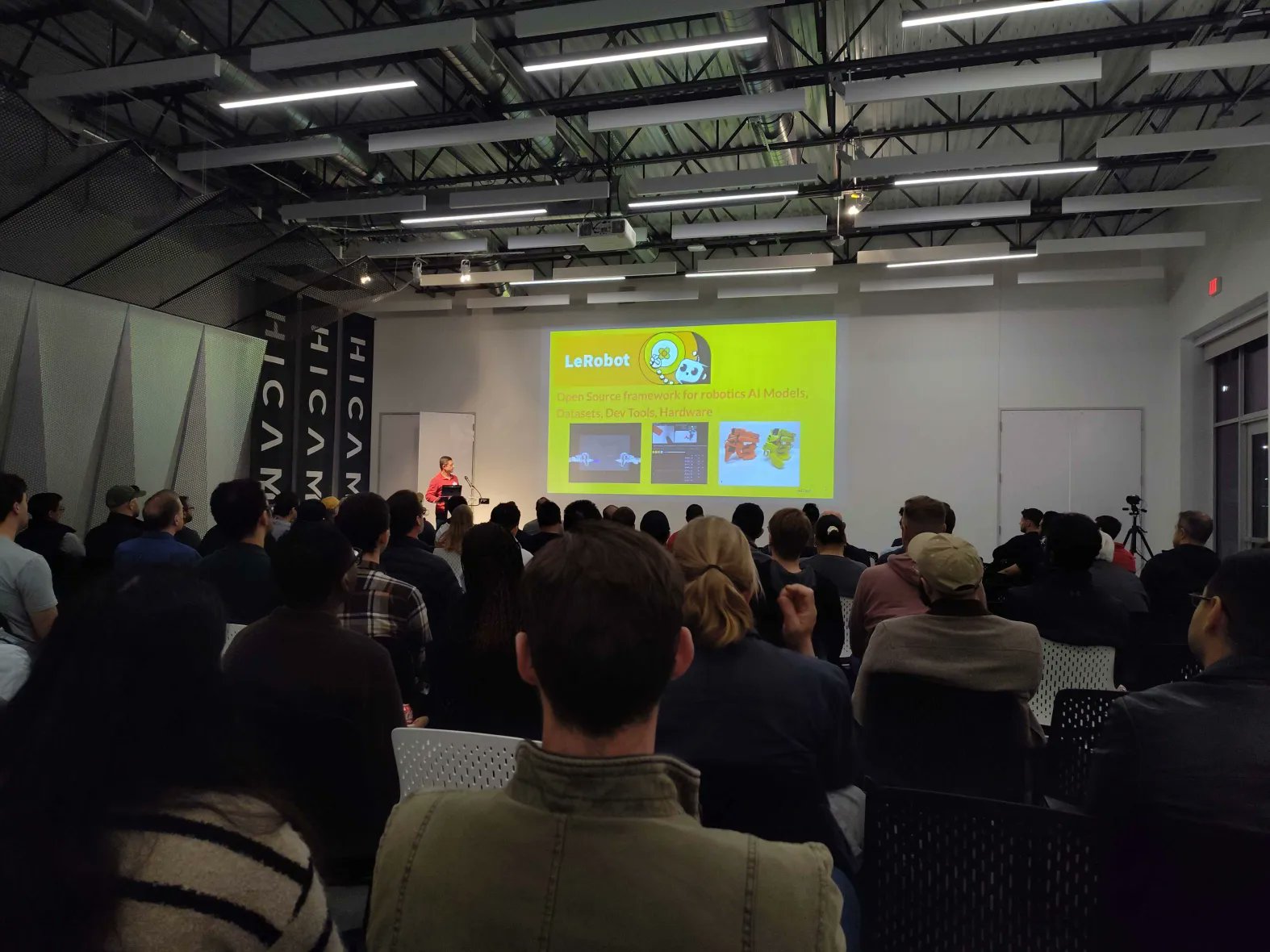
In February 2026, I presented zk0.bot at the Austin Robotics AI meetup, organized by Florin Matei and supported by HICAM and Skyways. What struck me most was how much the community has evolved. Just a few years ago, Austin Robotics was a focused DIY group. Now the room was filled with founders, builders, students, and investors—all drawn to the intersection of autonomous robotics and AI.
The talk covered the zk0.bot federated learning architecture, live demos of SmolVLA model training on SO-100 manipulation tasks, and the roadmap toward decentralized humanoid robot training. The Q&A was particularly energizing, with discussions ranging from regulatory implications to hardware requirements for running federated nodes.

Presenting federated learning architecture for robotics AI
Community Response
"Loved the variety of folks interested in autonomous robotics. Founders, builders, students, investors. Quite a change from the focused DIY group a few years ago."
Austin Python Meetup: Robotics AI Crosses Over
A few days later, I brought the same topic to the Austin Python Meetup—a traditionally software-only community. The fact that robotics AI is now crossing over into Python meetups signals a tectonic shift: the tools, frameworks, and mental models from the software world are becoming directly applicable to physical AI systems.
The talk focused on the Python ecosystem powering zk0.bot—from Flower's federated learning APIs to PyTorch-based model training and the CLI tools for node operators. For a room full of Python developers, the message was clear: you don't need a robotics PhD to contribute to the future of robot intelligence. If you can write Python, you can run a federated training node.


Austin Python Meetup
Organized by Florin Matei with support from Antler and George Mazzeo.
Austin Python Meetup recap — LinkedIn postRobotics AI crossing into Python meetups — LinkedIn postETH Argentina Devconnect: Decentralized AI Goes Global
In November 2025, I presented zk0.bot at ETH Argentina Devconnect at La Rural in Buenos Aires. This was the natural audience for the project—a web3-native community that deeply understands decentralization, cryptographic proofs, and incentive design.
The talk resonated because zk0.bot sits at the intersection of two powerful trends: the maturation of federated learning infrastructure and the web3 community's expertise in building decentralized coordination systems. The zero-knowledge proof component was particularly exciting for the Devconnect audience—zkML enables robots to prove they trained honestly without revealing what they trained on, a primitive that maps directly onto the trust assumptions that blockchain developers work with every day.
Why Decentralized Robotics AI Matters Now
The convergence of several trends makes this the right moment for decentralized robotics AI:
- Affordable hardware — SO-100 robot arms, Jetson boards, and consumer GPUs make it possible for individuals to participate in distributed training networks.
- Mature federated learning — Flower has evolved from a research framework to a production-grade platform capable of coordinating thousands of nodes.
- Regulatory pressure — The EU AI Act, evolving GDPR interpretations, and the US executive order on AI all push toward privacy-preserving training methods.
- Open source momentum — SmolVLA, LeRobot, and other open-source robotics models mean you don't need to train from scratch—you can fine-tune collaboratively on domain-specific data.
How to Get Involved
zk0.bot is fully open source and actively seeking contributors. There are several ways to participate:
- Run a federated node — If you have a robot arm or simulation environment, you can join the training network and contribute to improving the global model.
- Contribute code — The project is built in Python with PyTorch and Flower. PRs are welcome for model improvements, new datasets, and infrastructure tooling.
- Join the community — Follow the project on GitHub and join the Discord for discussions about architecture, roadmap, and collaboration.
Explore zk0.bot
Written by Ivelin Ivanov, founder of Pirin.ai and creator of zk0.bot. Published February 2026.