Jacob, Florin, George, and Chris keep Austin Python nights going. I am a friend of that room, a fan of the habit, and an occasional presenter. An Evening of Python Coding still gathers people who like to make something work in public, then talk about why it works.
The Austin Python Meetup has been a local choice through more than one tech wave. Peter Wang helped start it in 2008, years before he co-founded Anaconda. Jacob's Evening of Python Coding notes still credit him with initiating that night and organizing the Austin group. The tools in the room have changed. The traits that made people show up have not changed much.
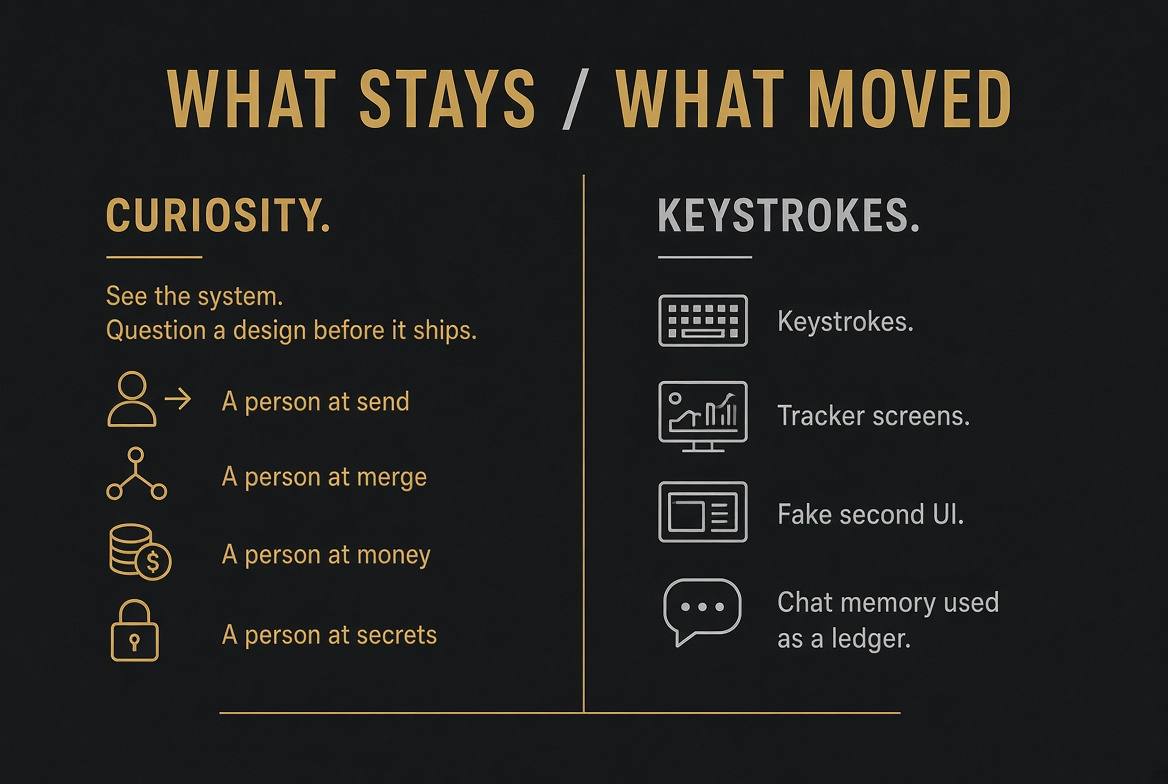
The tools around that habit are moving. Bots now type a lot of the code that used to fill the night. That can look like the night is over. It is closer to the opposite. Technology keeps changing. The human traits that made those rooms worth attending do not. Curiosity. The need to see a system. The need to sit with other people who will question a design before it ships. Communities that already serve those traits get a chance to pivot with the tools, instead of waiting to see what replaces them.
Nobody has a finished map of that pivot. We can still choose to take part in it.
Who this is for
People who still show up to a Python night, or who stepped back and are wondering what the night is becoming.
Also founders who just pointed an agent at email, files, or a company loop, and are trying to decide what still needs a human in the room.
Why the bots keep landing on Python
Ask a model for a script and do not name a language. On the small, common jobs, it usually answers in Python. A 2026 default-language benchmark across eleven models found that every model defaulted to Python on those tasks. An earlier study of eight LLMs found Python on 90 to 97 percent of language-agnostic benchmark problems, and still the most-used language even when it was a poor fit for the project.
That is not taste. It is training mass plus a language that is cheap to read and cheap to run.
Python ships a large standard library. sqlite3, pathlib, json, subprocess, email, http.client, argparse. A lot of glue work can stay inside those packages. No extra wheel to pin. No lockfile to babysit when a VM gets recycled or an OS image is rebuilt. The script is still there in the morning.
The same gravity shows up in agent work. Model SDKs, orchestration kits, and the official MCP Python SDK ship Python first. Agent skills are often just Python files an agent can write, import, and call again. A night that already thinks in that language is sitting on the default surface the bots use.
GitHub's 2025 ranking put TypeScript first by monthly contributors. That is real for the application layer. Training, research, tool loops, and "write me a script" still lean Python. Both can be true.
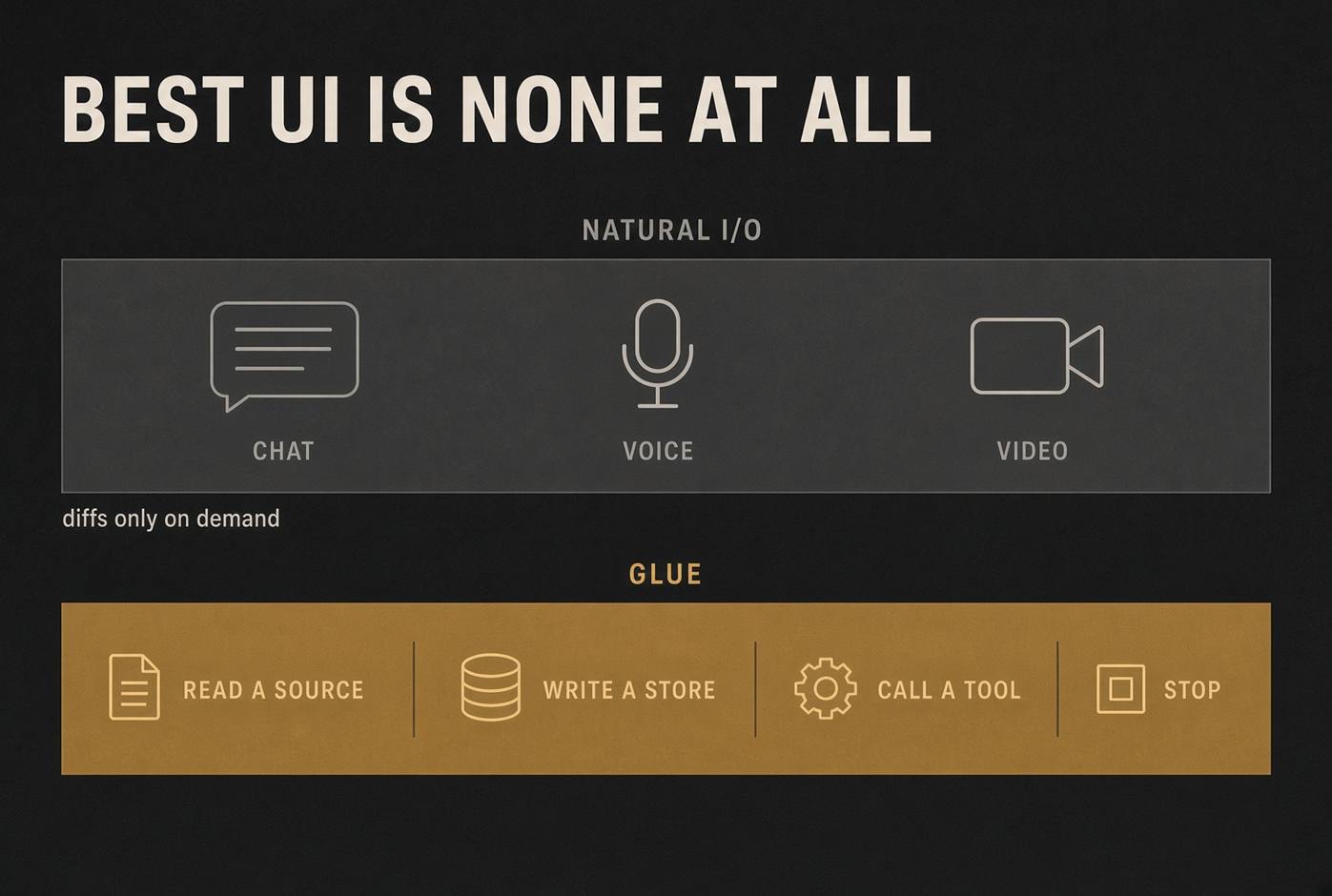
Lee Robinson at SpaceXAI, writing about Grok Bot, put it first: the best UI is none at all. Everyone already knows how to text. The hard work moves off the screen: a persistent computer, scripts, a browser when a site still has no API. That is more glue, not more chrome.
A lot of that glue is background work. Read a source. Write a store. Call a tool. Stop. Python already lives there. Code-mode kits now give the model one tool, run_python, instead of a dashboard full of buttons.
The remaining shell is less an IDE and more a natural channel. Chat. Voice. Video. Output in plain language, a chart, an infographic, a short clip. Point-and-click and typing boxes were there because computers needed them. They are not the interesting part of the job anymore.
People still open a diff. Less often as a ritual, more often when the agent cannot explain the change. 2026 engineering reports show review queues overflowing, more PRs merging unread, and humans moving up a level to intent and blast radius. A JetBrains survey found nearly half of professional code in a recent month was fully agent-written. That is not "the IDE is dead." It is the IDE becoming an on-demand pane behind a conversation.
That does not pull the background job back into the browser. If the useful loop leaves the screen, more of the load sits in the scripts. Those scripts are the same craft a Python night already practiced.
What stays, while the typing moves
The durable craft was never only the keystrokes. It was high-level, human-readable systems work. Connect a private source to a public one. Wire data and tools so a real job finishes.
AI already absorbs a lot of the typing. The traits that stay scarce look familiar: a person who can hold a whole design in their head, notice when a clever shortcut is the wrong store, and refuse to ship until someone has asked the boring questions.
Those are the same traits the night already selected for. The invitation can grow around them.
A small version of the conversation
An ops bot started reading inbound email. A sub-agent proposed remembering which messages were already marked by stuffing IDs into model memory. Cos, as Grok Bot Chief of Staff, approved that choice.
I questioned it.
Look at that as a system, not as a trick. Stochastic memory is a poor system of record for dedupe. Context balloons. Recall is not deterministic. The same mail can re-wake the bot. Adversarial mail can try to live inside the "memory" you asked the model to keep.
We went deeper. The model agreed the first design was not the better one. A tiny local SQLite table. A cheap garbage collect. Then LLM triage on what is new. Ordinary Python against a store you can query twice.
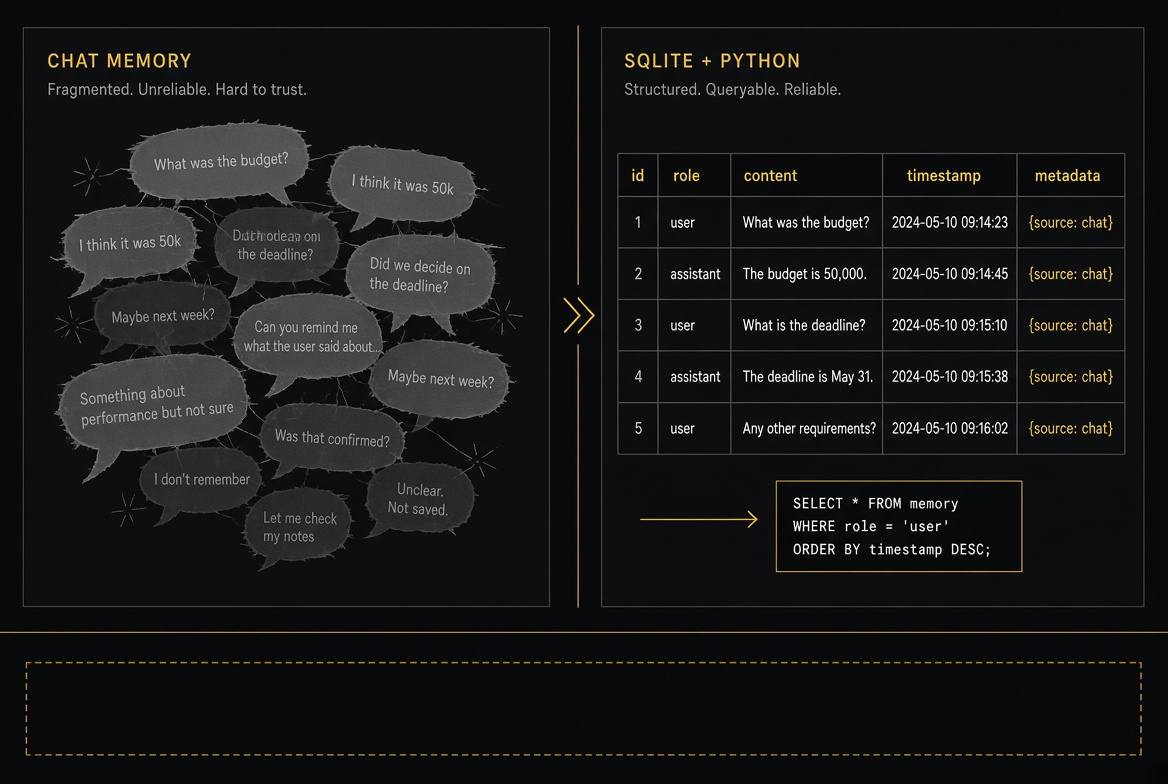
Same habit as the niche glue tools that move files and facts without inventing a second product. The store stays. The notification loop and the second UI do not have to.
Systems of record do not all vanish when agents arrive. Durable stores remain. The interesting work is deciding which loops still need a human, and which screens were only glue.
We do not know that SQLite is the last shape. We do know that treating chat memory as a ledger is a design choice, and design choices are what a night like this is for. A person still has to notice the first approval and ask again.
Where the work seems to be moving
The last decade often built a tracker first, then emailed people to push work through it.
A shape that is showing up now is more specialized tools agents can call directly. Humans keep the real gates: send, merge, money, secrets. A lot of the rest can be a connector, a skill, or a short script.
| Human traits the room already serves | Work those traits can pick up now |
|---|---|
| Wanting a store you can query twice | Putting state somewhere deterministic before the model sees it |
| Wanting a person at the irreversible step | Keeping send, merge, money, and secrets as gates |
| Wanting to join two systems without theater | Writing a connector or a short script an agent can call |
| Wanting to question a design in public | Reviewing an agent system the way we used to review a module |
This is a working sketch, not a doctrine.
If you want one public example of that kind of pack, there is an open template at github.com/ivelin/bootstrap. It is not the point of the night.
Participate, don't wait it out
Python nights still matter when they stay attached to the traits that filled them.
Show how you join two systems without a fragile memory hack. Show how you keep a real store and let a fake UI fall away. Show how you sit with a design until it has been questioned. Then argue about it, the way the room always did.
The bots will keep typing. That does not retire the people who like to understand what got typed.
Jacob, Florin, George, and Chris already keep a place for that. The rest of us can bring the next demo, or stay home and watch the shift from outside. Watching is available. Quitting is available. So is showing up while the shape is still unfinished.
Next
- If you host or attend a night like this, treat the current tools as material, not as a verdict. Bring a small system and the questions it raised.
- If a bot is already reading mail or files, put state in a store you can query twice. Leave the model the new work, not the ledger.
- Keep send, merge, money, and secrets as human gates until you have a better reason not to.
A forward look, not a promise: more niche reusable connectors will show up. Open ones for home and lab. Commercial ones for business. Agents need tools they can call, not only mega open-source umbrellas. That is the same craft, one layer up. The rooms that already gather people who like that craft are in a position to help invent it.