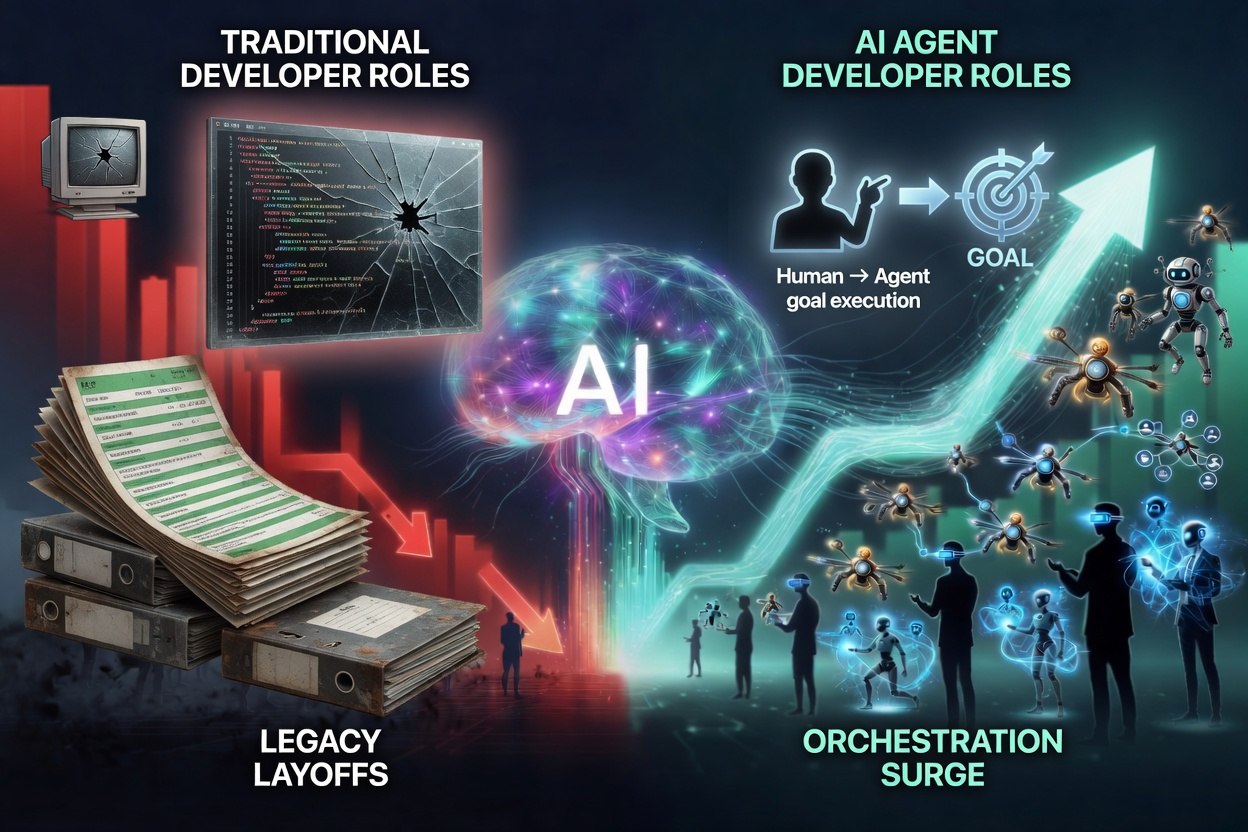
In Q1 2026, tech companies announced 81,747 layoffs — the highest quarterly total in at least two years. March alone accounted for roughly 45,800 cuts. At the same time, more than 67,000 open software engineering roles were listed at tech companies — up about 30 percent year-to-date and the highest level in over three years. Postings for software engineers rose 11 percent year-over-year in recent analyses. The Indeed Software Development Job Postings index, indexed to February 2020 at 100, sat near 73 in April 2026 after climbing from lower points in 2025.
These two trends run in parallel. One reflects announced workforce reductions. The other reflects current demand signals through job postings and open roles. The numbers come from distinct trackers: layoffs.fyi for cuts andTrueUp plus Citadel Securities reporting for openings. They do not cancel each other out. They describe different parts of the same adjustment.
📉 The Layoffs Data
layoffs.fyi recorded the 81,747 figure for Q1 2026 across tracked tech companies. Multiple outlets, including analyses from The Kobeissi Letter and Benzinga, cited the same source and noted the quarter-over-quarter jump exceeded 100 percent in some comparisons to late 2025. Cuts appeared at companies including Amazon, Meta, Microsoft, Oracle, and others. Reporting tied many announcements to shifts in spending toward AI infrastructure and efforts to reduce headcount in areas where automation or process changes reduced the need for certain roles.
For context, full-year 2025 totals varied by tracker. layoffs.fyi historical figures and secondary reports placed 2025 tech layoffs in the 122,000 to 165,000 range depending on exact scope and updates. The Q1 2026 pace exceeded half of several 2025 annual estimates. Not every cut targeted software developers exclusively — roles spanned engineering, product, operations, and support — but engineering and technical functions featured prominently in public announcements and aggregate data.
Broader Bureau of Labor Statistics information sector employment has shown net declines in recent periods, consistent with ongoing restructuring rather than outright expansion.
📈 The Open Positions Data
TrueUp data as of early April 2026 counted more than 67,000 open software engineering positions at tech companies. The year-to-date increase reached approximately 30 percent from the start of 2026. The same dataset showed levels roughly double the mid-2023 trough. Citadel Securities analysis of job postings described software engineer demand as "rapidly rising" with an 11 percent year-over-year gain.
The Indeed index for software development postings provides a longer view. After declining from earlier peaks, the index recovered toward 73 by April 2026. CompTIA's State of the Tech Workforce 2026 report projected 1.9 percent net growth in the overall U.S. tech workforce for the year, equating to roughly 185,000 additional positions across tracked categories. It also noted more than 275,000 active postings referencing AI skills in January 2026.
BLS occupational projections continue to forecast 15 to 15.8 percent growth for software developers, quality assurance analysts, and testers from 2024 to 2034 — well above the all-occupation average. These are long-term structural estimates, not short-term hiring guarantees.
The rebound in openings concentrates in specific areas. AI-related engineering, machine learning operations, cloud architecture, data engineering, and security roles show the strongest percentage gains in multiple datasets. Generalist or legacy application development postings have recovered more modestly from prior lows.
🔄 Historical Pattern
This combination of broad cuts and selective rebound matches earlier tech corrections.
After the 2000–2002 dot-com period, companies reduced headcount sharply in general web and infrastructure roles. Openings later increased in search systems, e-commerce platforms, and backend services. Talent reallocated. New specialized demand emerged while older categories contracted.
The 2022–2023 correction followed a similar sequence. Rapid hiring during 2020–2021 gave way to announced layoffs once growth rates normalized and capital conditions tightened. Postings stabilized and then rose again in cloud, data, and efficiency-related functions. The current period extends that sequence, with AI accelerating both the reduction in some tasks and the creation of demand for others.
Across multiple cycles, software developer employment has expanded over the long term even as individual waves produced layoffs. BLS data shows consistent net growth in computer and mathematical occupations through prior expansions and contractions. The mechanism is reallocation rather than uniform expansion or contraction.
🤔 What Explains the Parallel Trends
Companies reduced headcount in roles where AI tools, process automation, or workflow changes lowered the required staffing level. Reporting from multiple firms cited budget shifts from payroll to AI infrastructure spending. These cuts often occurred at profitable organizations as part of efficiency programs rather than distress-driven actions.
At the same time, building, deploying, securing, and scaling AI systems created demand for new or expanded skill sets. Roles involving model integration, data pipelines, agent development, MLOps, and AI-specific security require different capabilities than many legacy development positions. Postings data reflect that shift.
The result is skills polarization. Demand and compensation pressure remain high for engineers with demonstrated AI fluency and production experience. Availability of talent appears greater in adjacent or general engineering categories following the layoffs. Actual hiring rates can lag posting volumes because companies screen more selectively and because some openings represent backfills alongside net new roles.
Measurement differences matter. layoffs.fyi captures announced reductions, which can include planned future cuts. Job posting indexes capture active demand signals. Net employment in the information sector has not risen in lockstep with openings in every recent month, consistent with ongoing churn during a transition.
🛠️ Implications for Builders and Founders
The data describe a period of selective demand rather than uniform growth or collapse. Founders and technical builders face a clearer set of operational priorities.
Hiring windows exist in non-hottest categories. Experienced mid- and senior-level engineers displaced in recent cuts represent available capacity at terms more favorable than 2021 peaks for many roles. Move quickly on strong candidates; competition remains lower outside core AI/ML specialties. For AI-fluent talent, expect continued pressure from larger organizations and acqui-hire activity.
Product and engineering decisions benefit from explicit efficiency focus. AI tooling currently reduces time and cost for prototyping and certain implementation tasks. Builders who measure and document productivity gains or cost reductions gain an advantage when selling to enterprises that tightened budgets after their own restructuring.
Capital conversations have narrowed. 2025 venture data showed concentration in AI-related deals, with early-stage funding reaching fewer companies overall despite aggregate increases in some reports. Traction metrics tied to revenue efficiency or clear ROI outperform vision-only narratives. Acqui-hire structures have become a documented exit path for some AI teams, providing liquidity without requiring full-scale operations.
Skill development for founders and early teams should prioritize integration capabilities over pure model building. Ability to ship production systems that incorporate existing models, manage data flows, and address security and reliability produces faster results than undifferentiated wrappers. Generalist technical founders without recent AI exposure face longer hiring and validation timelines.
Risk parameters remain unchanged from historical baselines. Bureau of Labor Statistics and other longitudinal data continue to show roughly 20 percent of new establishments failing within the first year and approximately 45–50 percent within five years. Venture-backed outcomes follow power-law distributions with high attrition. The current environment does not alter those distributions; it changes the composition of surviving opportunities.
✅ Practical Steps
- Track primary sources directly. Review layoffs.fyi monthly releases and cross-reference with TrueUp or Indeed indexes for demand signals rather than relying on secondary summaries.
- When hiring, define required capabilities narrowly. Separate must-have AI integration experience from nice-to-have general engineering background. Test candidates on concrete production tasks rather than broad credentials.
- Build with measurable efficiency targets from the start. Instrument AI tool usage and track cycle time or cost-per-feature metrics. These data points support both internal decisions and external fundraising or sales conversations.
- Position offerings around documented customer cost or time savings. Enterprise buyers post-restructuring prioritize tools that reduce existing spend or headcount pressure over new capability alone.
- Maintain runway discipline. Capital availability favors companies with clear paths to efficiency or revenue. Assume longer evaluation cycles from potential customers and partners.
- Reassess team composition quarterly against current posting and skills demand data. The fastest-moving categories remain AI-adjacent engineering functions. Adjust hiring and upskilling priorities accordingly rather than maintaining prior role distributions.
📊 Key Metrics at a Glance
| Metric | Value | Source | Signal |
|---|---|---|---|
| Q1 2026 Tech Layoffs | 81,747 | layoffs.fyi | 🔴 Highest in 2+ years |
| Open SWE Positions | >67,000 | TrueUp / Citadel | 🟢 +30% YTD |
| Indeed SWE Index | 73 (Feb 2020 = 100) | Indeed | 🟡 Recovering |
| AI-Skills Postings (Jan 2026) | 275,000+ | CompTIA | 🟢 Surging |
| BLS SWE Growth (2024-34) | 15–15.8% | BLS | 🟢 Well above avg. |
| Net New Tech Jobs (2026 proj.) | ~185,000 | CompTIA | 🟢 Modest growth |
The dual trend reflects reallocation during a technology transition. Announced reductions free resources that appear in new demand signals for different capabilities. Historical cycles show this pattern produces both attrition and new formation. Builders who align operations, hiring, and product priorities with the observed data on efficiency and specialization operate from the same information set as larger organizations executing similar adjustments.
🚀 Built with these trends in mind. Pirin.ai exists to help non-technical founders and builders turn ideas into working products without coding. If you're navigating this shifting landscape and want to build with AI agents, join our program today.