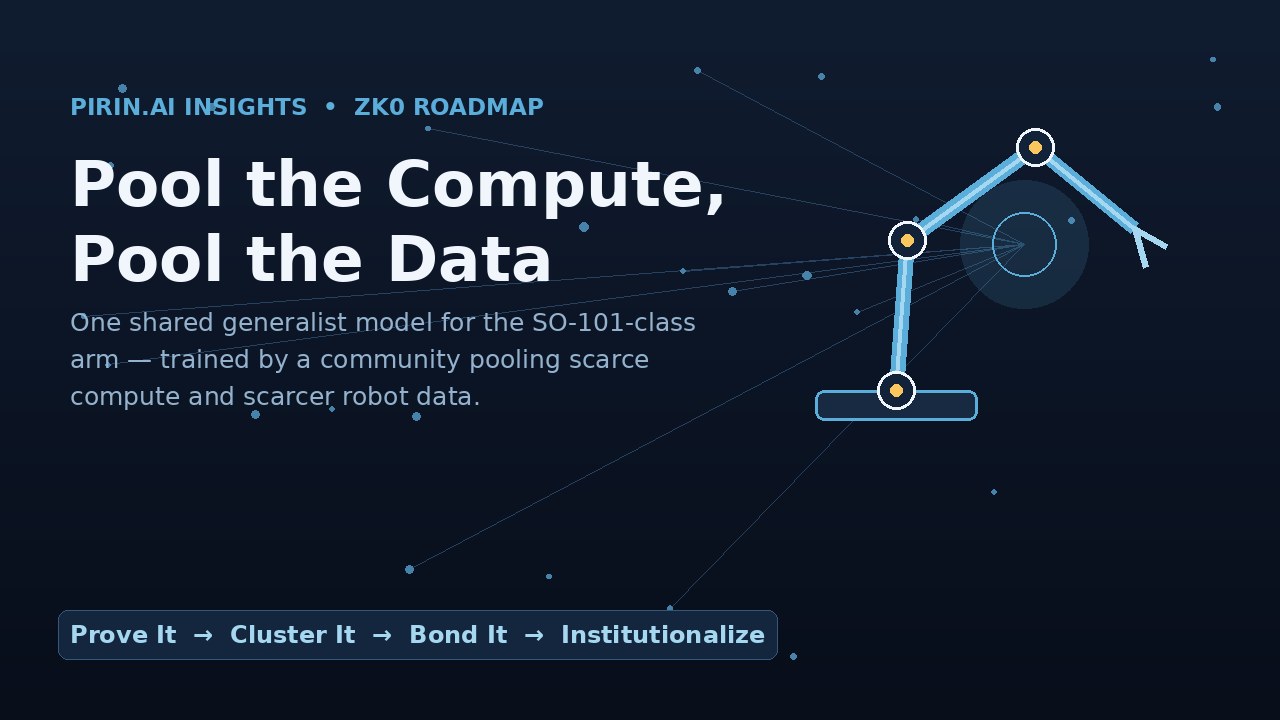
Pool the Compute, Pool the Data: The zk0 Roadmap
Last week we made the founder case for zk0, the open federated-learning project training a shared robot model on community data: for a robot arm, data beats parameters. This week zk0 published the plan that follows from that bet — the full, canonical roadmap is live at zk0.bot/docs/ROADMAP.html. This article is the short version for Pirin readers; the roadmap itself is the source of truth.
The bet
Compute is increasingly hard to come by. Robot data is even scarcer. No single small lab, startup, or enthusiast can collect enough diverse, real robot trajectories — across tasks, objects, environments, and slightly different arms — to train a robust generalist model alone. A few massively funded companies can try, and even they struggle with the long tail.
So zk0 pools what is distributed: the compute already sitting next to the data, and the private robot episodes that already exist on owners' machines. The product of the pool is one shared model — in the SmolVLA class, 450M parameters today — for a stationary SO-101-class arm, meant to work on many tasks out of the box, with no per-task fine-tune-and-forget cycle. A candidate checkpoint is promoted only if it passes the accumulated task battery with no regressions.
Privacy is a bonus here, and an enabling condition — not the headline. Keeping data local is the mechanism that lets real deployment data enter a pool at all. The headline is reciprocity, with audited, value-weighted contribution accounting: you contribute, the shared model improves on other people's held-out tasks, that improvement is measured, and your credit reflects the measured transfer — not raw episode counts. There is no token and no chain.
The honesty, up front
The roadmap opens with what is not established, because a plan built on unmeasured claims is marketing, not a roadmap:
- Zero rollout success rates have been published yet. Every number in zk0's published record so far is policy loss — and loss is not task success.
- No local-only baseline has been published. The federated-vs-local comparison the thesis depends on has not been run in public, by zk0 or by anyone in the form needed.
- Federation has never beaten centralized pooling on real robots in print. The only real SO-101 federation study available found federated training trailing centralized by 15.8 points at 2 sites and 24.5 points at 3 sites — and the measured cause was per-arm calibration differences, not the aggregation algorithm.
The plan below is built around measuring exactly those gaps.
The plan: four phases, gated by traction — not dates
- Prove It (now, community tier): light, visible trust machinery — signed checkpoint provenance and a transparency log, commit-reveal updates, calibration attestation, and credit that accrues when a contribution measurably improves other nodes' held-out evaluations.
- Cluster It: near-peer, competitor-free clusters, with reputation-weighted aggregation, slow-vesting standing, and screening for replayed or mislabeled data — with measured transfer as the final arbiter.
- Bond It (paid tier): when money flows, defenses get economic teeth — operator stake bonds slashable only on proof of malicious behavior, norm/range proofs on updates, and aggregator correctness proofs. Borrowed from public-blockchain research; still no chain, no token.
- Institutionalize: threshold checkpoint signing, a steward council with pre-committed release criteria, audits, and differential-privacy tiers for participants whose legal or contractual needs require them.
Each phase unlocks on a traction signal, not a calendar date. The planning number is stated plainly: a retained core of 10–20 committed operators beats vanity node counts.
M0 and M1: fix the defaults, then run the decisive experiment
M0 — fix the defaults first. Calibration standardization plus action normalization becomes a protocol-blocking node-join requirement: an uncalibrated or unnormalized node cannot join a counted round. That is the one intervention aimed directly at the measured 15–25 point real-robot federation gap. Rounds carry full action-expert fine-tunes, not LoRA-only adapters, and the harness A/Bs the aggregator — FedProx with dynamic scheduling, the incumbent in zk0's configuration, against FedAvg, which won in other configurations — and publishes the result either way.
M1 — the decisive experiment. Four arms, same starting checkpoint, same total data, same task family: local-only, federated, centralized pool, and federated + calibration normalization, judged on held-out sites and held-out objects. The bars are pre-registered before results are seen:
- ≥ +10 percentage points over the best local-only arm on held-out sites/objects.
- Parity within ~5 percentage points of centralized = success. Superiority over centralized is not claimed, and is not the bar.
And the kill criterion is pre-committed, in writing, before the experiment runs:
If federated + calibration normalization still lands more than 10 percentage points below centralized pooling on held-out sites, federation repositions to a privacy wrapper, and centralized community pretraining becomes the engine.
Recruitment for credible evidence is 8–12 sites — not a three-node smoke test presented as evidence.
Execution: weekly milestones, Monday workshops
Momentum you can check, not a launch spike: zk0 publishes one tangible milestone per week for the first eight weeks — the M0 protocol spec, a verified node quickstart, an external-node onboarding kit, a data-contribution sprint kit, the provenance/transparency design, aggregator A/B results in simulation, and the M1 pre-registration. If a week slips, the milestone slips with it and zk0 says so.
A Monday workshop series runs alongside: node setup, the calibration standard, a data-contribution sprint, local training and first rounds, reading results and eval integrity, and the M1 experiment and clusters. Each session is working, not a lecture — bring an arm or a GPU, leave with the week's stage working.
Who this is for
Two contributor classes, now:
- SO-101 owners with private episodes. Your arm, your demonstrations, trained on where they already sit. Bring episodes; leave with a live node and a shared model that does more than your local model alone — measured, not asserted.
- Compute contributors with a 10GB+ VRAM GPU. SmolVLA fine-tuning fits in roughly 10–16GB of VRAM. Ordinary consumer GPUs count, and you do not need an arm to contribute compute.
Join the conversation in the zk0 Discord: discord.gg/dhMnEne7RP.
The full plan — phases, integrity commitments, product stages, and the claims discipline zk0 holds itself to — is the canonical page: zk0 Roadmap: Pool Compute and Data for Physical AI. Background: The Community Is the Dataset and Decentralized Robotics AI: Building zk0.bot.